
Cost of a Padel Court in 2026
9 September 2026
Artificial Turf Granule Prices 2026: The Cost of SBR, EPDM and Sand Infill
13 September 2026
Construction of artificial turf pitches in Izmir, even if a project in Ankara or Istanbul were carried out to the same technical specifications, the decisions that keep the site going for years are made elsewhere: it is not the snow load in winter but the surface temperature in summer; not the mountain winds but the sea breeze; and not solid rock but, more often than not, alluvial or fill soil. In this article, we have compiled the cost ranges for 2026, technical considerations specific to Izmir, and the questions that should be asked when comparing quotes for local authorities, schools, housing estate management boards and businesses considering the construction of open-air or indoor artificial turf pitches in Izmir.
- Scope: Site survey and infrastructure, drainage, artificial turf and infill, wire mesh and netting, lighting, steel structure for the indoor pitch
- Discovery: On-site measurements in the central districts of Izmir and in surrounding districts such as Menemen, Torbalı, Kemalpaşa, Urla and Çeşme
- Delivery: Turnkey; documentation in accordance with the technical specifications for public sector projects
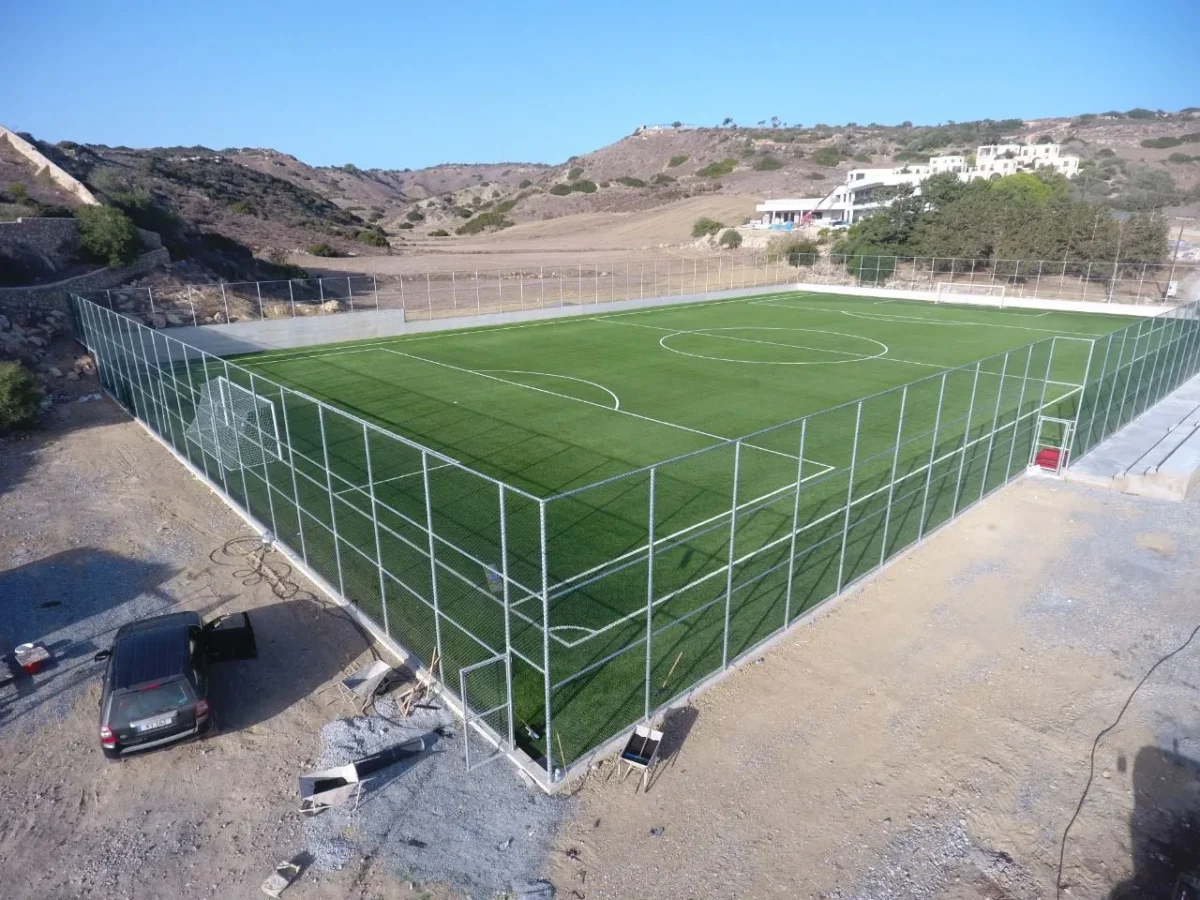
The cost of building an artificial-turf pitch in Izmir (2026)
The following packages cover a turnkey project: ground preparation and drainage, standard synthetic turf and infill, perimeter fencing and netting, and basic lighting. Figures This is a market forecast for 2026; the final cost will be calculated item by item, based on the survey and ground conditions.
| Field type | cost per square metre | 25 × 45 m (1,125 m²) | 30 × 50 m (1,500 m²) |
|---|---|---|---|
| Outdoor artificial pitch | 1,900 – 2,500 ₺ | 2.14 – 2.81 million ₺ | 2.85–3.75 million ₺ |
| Indoor artificial-pitch football ground | 3,500 – 4,500 ₺ | 3.94–5.06 million ₺ | 5.25 – 6.75 million ₺ |
| Renewal of the turf and infill on the existing pitch | If the infrastructure is sound, it accounts for only a small proportion of the cost of the new pitch; drainage and ground settlement are assessed during the site survey | ||
Three items that have altered the budget in Izmir:
- Transport and crew: Our head office is in Ankara; for projects in Izmir, the cost of supplying turf, fill and structural materials, as well as the team’s accommodation, is listed as a separate item in the quotation. This item decreases per square metre as the site area increases; including more than one site under the same contract also reduces its proportion.
- Floor: Groundwater levels may be high and bearing capacity may be low in coastal reclamation areas and on alluvial plots in the Gediz and Küçük Menderes plains. In these plots, the excavation depth, stabilisation thickness and drainage requirements increase significantly.
- Beach material: In coastal areas, the thickness of the galvanised coating, PVC-coated wire and stainless steel fasteners increases the unit price; however, it directly extends the service life of the netting and posts.
How does the climate in Izmir affect the artificial-turf pitch?
Summer temperature and surface temperature

In Izmir, air temperatures frequently exceed 35 °C on afternoons in July and August. The surface of synthetic turf exposed to the sun reaches temperatures well above the ambient air temperature; black rubber granule infill, in particular, retains heat. This has three consequences for the pitch:
- Opening hours are extended into the evening. In summer, the majority of demand is after sunset; therefore, in Izmir, lighting is not an “add-on” but a revenue-generating part of the venue. The number of floodlights, the height of the poles and the choice of LEDs must be clarified in the initial quotation.
- The choice of filling becomes important. Filling systems that use light-coloured coated granules or contain less rubber help to reduce surface temperature, but increase the unit price. Options and costs per m² Artificial turf granule prices We compared them in our article.
- Ventilation is essential in enclosed spaces. In Izmir, covered courts are built not to protect against snow, but to provide shelter from the rain and sun. Whether the side panels of a fully enclosed tarpaulin-covered court can be opened or left as netting determines its suitability for use in summer.
Sea breeze and coastal wind
The imbat, a breeze blowing in from the sea on summer afternoons, is a regular wind around the Gulf of Izmir; it is even stronger in the direction of Çeşme, Urla and Karaburun. The wind exerts force on the netting and truss system, much like a sail. In areas with tall cages, the mast cross-section, mast spacing and foundation dimensions must be selected according to the wind load; in enclosed areas, the wind—rather than snow—is often the determining load in the calculation of the roof covering and connections.
Salty air and corrosion
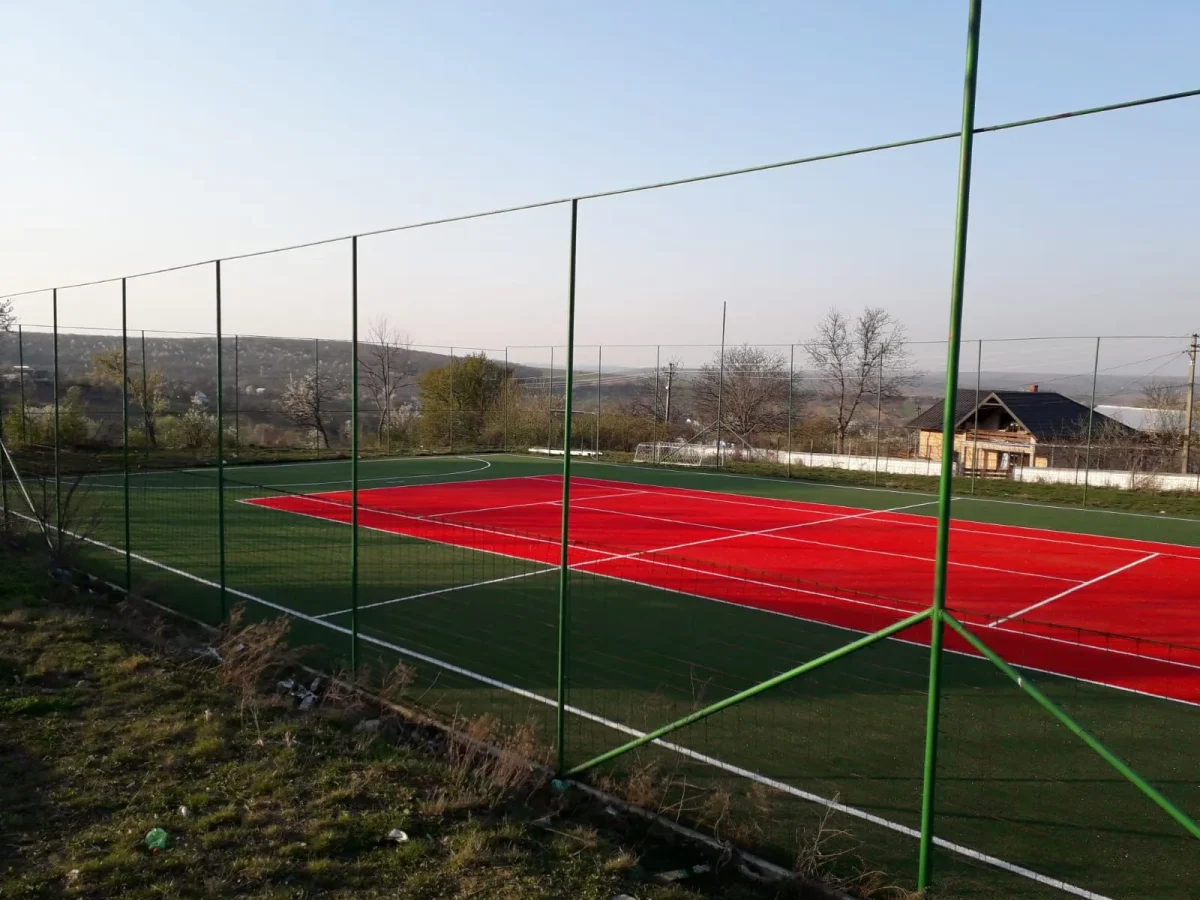
In coastal districts such as Karşıyaka, Bostanlı, İnciraltı, Güzelbahçe, Urla, Çeşme, Foça and Dikili, salt-laden moisture causes steel components to rust much more quickly than in inland areas. For projects located near the coast, the following should be specified in the tender documents:
- In masts and structures hot-dip galvanising and, if applicable, a paint system
- PVC-coated wire mesh and tension wires
- Stainless steel or galvanised components for clamp, bolt and mesh connections
Rainy season
In Izmir, the majority of rainfall occurs between December and February, falling in short bursts with high intensity. Drainage capacity should be sized not according to total annual rainfall, but according to these downpours. On plots where water beneath the turf cannot be rapidly drained away from the site, fill material is carried to the surface and the site loses its evenness during the first winter.
Soil and earthquakes: the two key issues to consider in Izmir
Soil investigation. Even within the same district, one plot may be on solid ground, whilst the one next to it may be on old fill. On alluvial and fill soils, if work on the infrastructure begins without compacting the sub-base after excavation, the site will settle in places within a few years; on synthetic turf, this settlement manifests as water pooling and seams opening up. If an enclosed pitch or a raised pitch is planned, the ground investigation should be discussed during the preliminary survey stage.
Earthquake. Izmir is classified as a high-risk area on the Turkey Earthquake Hazard Map. Load-bearing structures such as indoor artificial-turf pitches, stands and tall lighting masts must be structurally calculated in accordance with the Turkish Building Earthquake Regulations. If the quotation does not specify the “structural analysis” or the earthquake and wind parameters used, that price may not reflect the same scope of work as other quotations. For further information on steel-framed indoor sports halls, Construction of an indoor artificial turf pitch You can take a look at our page.
Is it open or closed in Izmir?

| Criterion | Open-air venue | Indoor venue |
|---|---|---|
| Usage during the year | As the climate is temperate, it can be used for most of the year; rainy winter days and summer afternoons are wasted time | Regardless of the weather; if there’s no ventilation plan in place for the summer, midday is still a challenge |
| Cost per square metre (2026 forecast) | 1,900 – 2,500 ₺ | 3,500 – 4,500 ₺ |
| Key technical issue | Drainage, lighting, and the cage’s resistance to wind and corrosion | Earthquake and wind calculations, ventilation, planning permission |
| Who is it suitable for? | Municipality, school, housing estate; a business based on evening hire | A business aiming for uninterrupted rental income even during the winter season; a corporate sports facility |
In continental climates such as Ankara’s, indoor growing often speeds up the return on investment. In Izmir, however, a well-lit area with proper drainage open space, it can be let for most of the year with a budget amounting to nearly half the investment. The decision on whether to opt for an indoor facility should be based on whether the lost hours during the winter months would justify the additional construction investment. If the budget is insufficient at present, the foundations for an outdoor facility can be laid in such a way that it can be enclosed at a later date.
Which field is for whom?
| Employer | Typical requirement | Proposed system | Please take note in Izmir |
|---|---|---|---|
| Local authority and public body | Public area, heavy use in the evening | 30 × 50 open-air pitch, 50–60 mm grass, 6–7 m goalposts, LED floodlights | The corrosion class and wind calculations for coastal parks must be specified in the specifications |
| School | For student use only, limited garden | 20 × 40 or 25 × 45 open-air area; with a multi-purpose acrylic area alongside it | The project must be completed within the summer holidays; shade and a water point are required due to surface temperatures |
| Site and housing project | A small plot of land belonging to the residents | Mini pitch or 20 × 40 open-air pitch, with a net-covered enclosure | Light and noise from night-time use affecting neighbouring properties; lighting control |
| Business | Hourly rental income | 1–2 open-air pitches + changing rooms; a foundation that can be covered in the future | Quality of lighting for evening use, car park, and drainage capacity sufficient to cope with winter downpours |
The application process and the most suitable time
- Survey and measurement: The area is measured, the type of ground and water conditions are assessed, and the intended use and operating hours are discussed.
- Tender and technical specifications: Items such as turf and backfill values, sub-base layers, drainage, mesh and lighting are listed item by item; corrosion protection is also specified in coastal projects.
- Permissions: Municipal planning permissions for enclosed spaces and permanent structures are the employer’s responsibility; we prepare the project and structural analysis documentation.
- Application: Excavation and levelling → drainage → sub-base and concrete footings → posts and wire mesh → laying of synthetic turf → sand and granule infill → marking lines → lighting.
- Delivery: Including material certificates, warranty and maintenance instructions.
| Work | Typical duration | Circumstances that extend the time limit |
|---|---|---|
| Outdoor artificial turf pitch (from scratch) | 3–6 weeks | Additional excavation and compaction on alluvial/fill soil, winter downpours, concrete curing period |
| Indoor artificial-pitch football ground | 8–14 weeks | Structural fabrication, structural design and planning permission |
| Turf and infill renewal | 1–2 weeks | Removal and disposal of old turf; infrastructure repairs |
The most suitable period for outdoor turf laying in Izmir is between March and June and between September and November. Work can be carried out in July–August, but as the working time of the turf adhesive is reduced in the heat, laying is scheduled for the morning hours. Downpours in December–February may halt excavation and infrastructure work for a few days.
8 questions to ask when comparing quotes in Izmir
- Lawn: Are the yarn count, yarn type, dtex and stitch density specified?
- Filling: Have the quantities of sand and granules been specified in kg/m², and has the type of granule (SBR, coated, EPDM/TPE) been stated?
- Floor: Are the excavation depth and the thicknesses of the stabilised layer and gravel specified? Have any additional measures been planned for the alluvial soil?
- Drainage: Are the pipe diameter, spacing and the point where the water will be connected known?
- Cage: Is there any information available regarding the height, pole cross-section and spacing, and galvanised and PVC coating?
- Lighting: Are the number and wattage of the luminaires, the height of the poles and the lighting layout available?
- Indoor venue: Have the structural calculations, earthquake and wind parameters, and ventilation design been documented?
- Delivery and warranty: Are transport and team costs included in the price, or are they charged separately? What are the separate costs for the grass and labour?
A quote that omits one of these items will usually appear cheaper; the difference becomes apparent in the form of drainage problems during the first winter’s downpours and issues with the mesh and infill during the first summer. For the dimensions and installation details of a 30 × 50-metre pitch, Construction of a 30×50 artificial turf pitch In our article, for projects in standard format Construction of a FIFA-standard football pitch You can take a look at our page.
Frequently Asked Questions
How much does it cost to build an artificial turf pitch in Izmir?
Based on the 2026 market forecast, the price range for a turnkey outdoor artificial turf pitch is 1,900–2,500 ₺/m², whilst for an indoor artificial turf pitch it is 3,500–4,500 ₺/m². A 30 × 50-metre open-air pitch costs approximately 2.85–3.75 million ₺, whilst an indoor pitch of the same size costs 5.25–6.75 million ₺. In projects in Izmir, transport and labour costs are listed as separate items in the quotation; the final cost is determined following the site survey.
Is an indoor artificial-pitch football ground a must in Izmir?
It is not a requirement for most projects. Izmir’s mild climate allows the open-air court to be used for most of the year; the main lost hours are during winter downpours and summer midday heat. An indoor facility makes sense for businesses aiming for uninterrupted rental income during the winter season, but in Izmir, an indoor facility closed off without a proper ventilation plan may become unusable in the summer.
What should you bear in mind when working in an area close to the sea?
Salty air causes steel poles, wire and fasteners to rust rapidly. In coastal projects, hot-dip galvanised poles, PVC-coated wire mesh and stainless steel or galvanised fasteners should be used; furthermore, the pole cross-section and foundation dimensions must be selected according to the wind load for sea breezes and coastal winds.
Does artificial grass get very hot in the summer?
Yes, the surface of synthetic turf in direct sunlight heats up significantly above the ambient air temperature, and black rubber granules exacerbate this effect. Light-coloured granules, infill systems that use less rubber, good lighting for evening use, and shaded areas and water points around the pitch are ways of managing this issue.
Can an artificial turf pitch be built on alluvial soil?
It is feasible, but the bearing capacity of the ground and the groundwater level must be assessed during the site investigation. On plots of this kind, deeper excavation, geotextile, a thicker stabilised layer and reinforced drainage may be required; if these measures are not taken, the site will settle in places within a few years.
Do the earthquake regulations apply to artificial-turf pitches?
The groundworks for the open-air area are not directly relevant; however, as the enclosed area’s structure, the stands and the tall lighting masts form a load-bearing structure, they must be structurally calculated in accordance with the Turkish Building Seismic Regulations. As İzmir is a province with a high risk of earthquakes, it is essential to enquire whether the structural calculations are included in the tender.
In which districts of Izmir do you work?
We are planning site surveys for projects in the central districts of Izmir and the surrounding districts. As the team and materials are being dispatched from Ankara, we will finalise the survey dates and transport costs together during the tender stage.
How long does it take to build an artificial turf pitch?
An open-air artificial turf pitch built from scratch is usually completed in 3–6 weeks, whilst an indoor pitch takes 8–14 weeks. In Izmir, additional excavation and compaction on alluvial or filled ground, and heavy downpours during the winter months, are the main factors that prolong the construction period.
Site survey and quotation for your project in Izmir
We assess the dimensions of the site, the condition of the ground and the intended use, and prepare a detailed quotation. We provide support for the preparation of technical specifications for local authority and school projects, as well as for feasibility studies for open and enclosed areas in commercial premises.
Telephone: (0530) 466 63 76 | WhatsApp: Send a message
Email: info@turksas.com